

Backgrounder: Shipping and manifest services
Terms and definitions for shipping and manifest services
Knowledge of the following terms will help you understand shipping and manifest services.
| Term | Description |
|---|---|
| Shipment | A single physical item to be shipped by Canada Post. Shipments have a logical counterpart: the collection of data about the shipment. Your shipping system provides the data to Canada Post so Canada Post can deliver the shipment according to your preferences and specifications. |
| Group | The purpose of a group-id is to group several shipments together to include on the same manifest. For example, grouping is useful in the following scenarios:
A group controls which shipments are grouped together in one Transmit Shipment request and consequently which shipments are grouped together for billing of manifests. Key features:
Additional behaviour of groups is described further under Manifest. |
| Manifest | A manifest is proof of payment for a collection of physical shipments. If your shipment contains multiple packages and your shipping labels state 'manifest required', you must provide a hard copy manifest to Canada Post when we pick up your shipments or when you drop off your shipments at a mail processing plant. To create a manifest, you must use the Transmit Shipments web service call. Transmit Shipments is a mandatory call. It triggers the upload of shipment data for billing and tracking systems. The response from a Transmit Shipments call provides you with the information you need to invoke the Get Manifest web service and then the Get Artifact service, which in turn allows you to print your manifest. We monitor all shipments that have not followed this process. If you don’t provide a manifest, you’ll be billed for all unpaid shipments and be subject to additional surcharges. Manifest groupings are created by Canada Post logic after a transmit request is made for one or more customer group codes. The Canada Post logic creates groupings required to segregate the shipments for billing or delivery purposes. For billing, manifests are segregated by the payer customer number. For delivery purposes, manifests are segregated by domestic, U.S., and international destinations and drop locations. |
Lifespan of shipments, groups, and manifests
Shipments
Logical shipments are kept on Canada Post servers until 90 days after they’ve been transmitted. This represents 90 days after the physical shipment was picked up or deposited. The logical shipments are referenced in web services by the Canada Post system-provided unique shipment-id. After transmit, for shipments that support tracking, the tracking-pin number is used as a reference rather than the shipment-id. It’s also possible to use a customer provided reference number for tracking.
Untransmitted shipments aren’t deleted from our servers until they’re either transmitted or voided, in which case they’ll be deleted after 90 days.
Groups
A group is created for any unique value that’s passed by your application when a Create Shipment request is made. A group will become empty when it’s referenced in a Transmit Shipments request. Empty groups are deleted overnight. There’s no issue with re-using a group that was previously referenced in a Transmit Shipments request.
Manifests
Manifests are created when the Transmit Shipments request is made. Manifests exist for the same amount of time as the shipments they contain (90 days).
The following is the hierarchy of the shipment entities for a customer mailing for themselves from one location:
Standard hierarchy
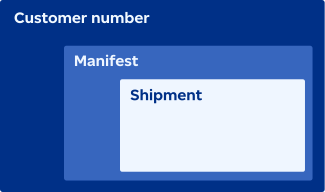
A diagram illustrating the standard hierarchical relationship between a customer number and its shipments. A single customer number can have multiple manifests, and each manifest can contain multiple shipments.
The following is the hierarchy of entities for a customer mailing on behalf of others or from multiple locations:
Advanced hierarchy
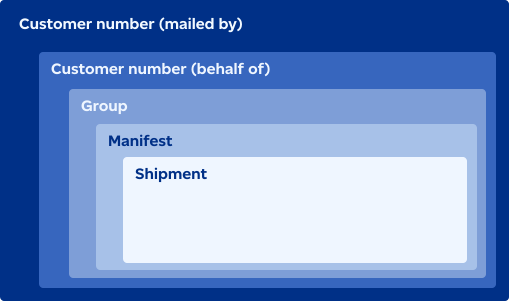
A diagram illustrating the advanced hierarchical relationship between customer numbers, groups, manifests, and shipments. A single customer number can mail on behalf of another customer number, which can be part of a group. Each group can have multiple manifests, and each manifest can contain multiple shipments.